

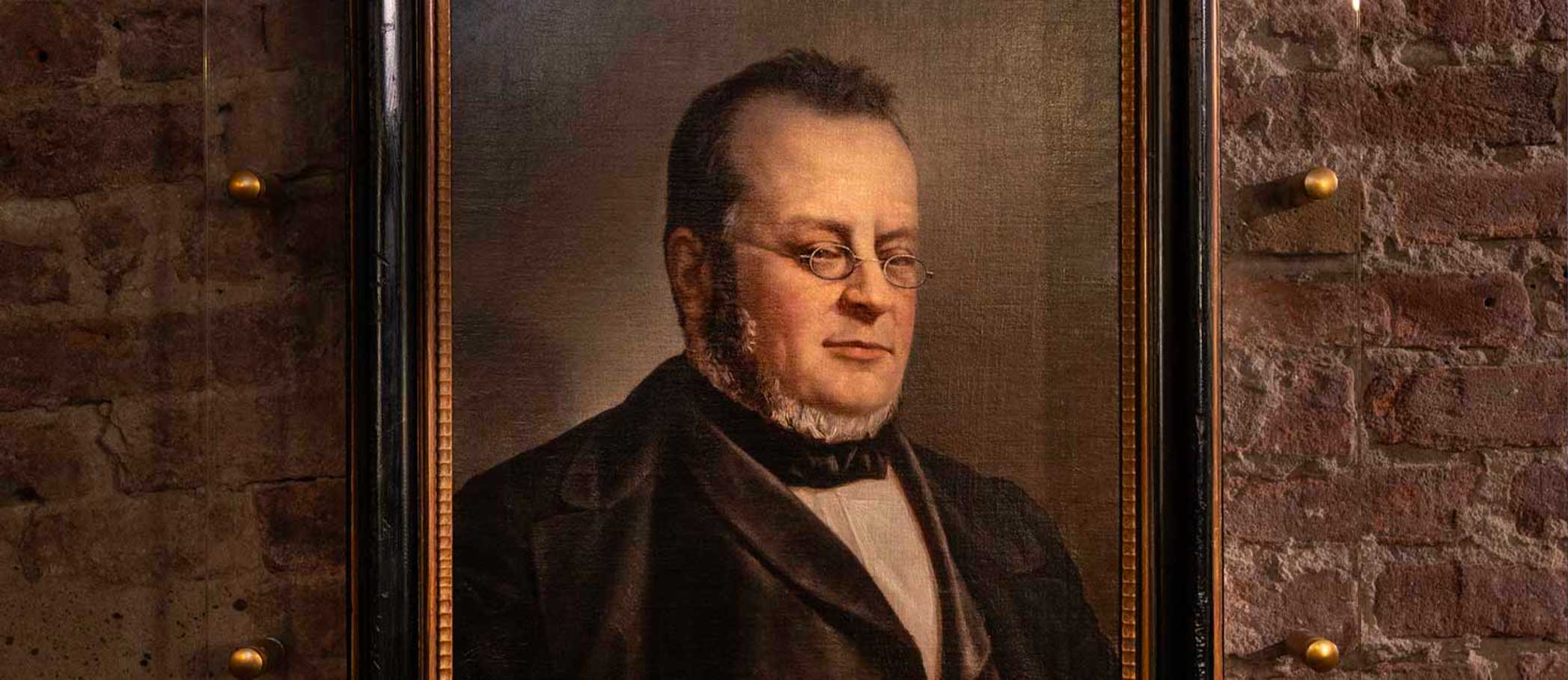
Count Cavour:
father of Italy and illustrious guest of the Castle.
Count Camillo Benso di Cavour, the architect of the Risorgimento and the Unification of Italy, is undoubtedly the most famous person to have resided in the Castle, contributing to its prestige and fame.
The Count spent the years prior to his entry into politics at Grinzane (which only later, in his honour, would add the word “Cavour” to its name). He was sent there by his father, Marquis Michele Benso, to run the property he had rented out from his sister-in-law, Duchess Vittoria de Sellon.
Michele’s intentions were also to keep his bright son out of trouble, as he already had a strong passion for politics and was making odd speeches about the possible unification of Italy led by Piedmont.

When young Camillo arrived at the Castle
he brought good administration
and new ideas.
So, at the age of just 22, Count Camillo found himself mayor of Grinzane and, in September 1832, he moved to the small village of the Alba area…
Upon his arrival he realized that in the village there were only three hundred and fifty inhabitants, mainly peasants and labourers who, when they met him, called him Excellency and Most Illustrious. Grinzane was so tiny and insignificant that there was not even a decent place to convene the Town council!
Everything was in disarray, especially the cellars. There was little production, peasants and day labourers spent their time in idleness and people stole with impunity. Camillo sacked the dishonest and idle men and devoted himself with passion and determination to improve the condition and efficiency of the farm estates around the Castle, starting with the vineyards, adopting the most modern cultivation techniques available at the time.
Apparently, he kept everything under control, writing down in a notebook all the operations carried out on the estate: manuring, managing the stables, selling cereals and wine, collecting debts and paying taxes, and so on.
His love for these places was so great that he remained mayor of Grinzane for 17 years, until 1849.
A great passion not only for accounting,
but also for “vin bun” (good wine).
Cavour, although quite young, immediately understood the backwardness of his vineyard cultivation techniques and winemaking processes, which resulted in the production of a poor quality Nebbiolo.
In 1836, he called in Marquis Pier Francesco Staglieno, a former general of many honours and an expert oenologist, as his consultant. Staglieno introduced substantial innovations, such as fermentation in closed rather than open vats, to reduce must oxidation, and the use of sulphur to ensure longer wine preservation.
In the late 1830s, Nebbiolo wine from the Count’s estate began to be sold in bulk throughout the Kingdom of Sardinia.
In 1848 Staglieno was succeeded by Louis Oudart, a French oenologist who set to work to obtain a dry and aged wine, based on the Bordeaux model. Another major innovation was the purchase of the first 1,000 glass bottles from France. The following year, the first 100 bottles of ” old wine 1844″ were bottled. This was probably the first bottled vintage of Barolo, the progenitor of the modern history of the king of red wines and its vintage.
Who was Cavour.
To all Italians, Cavour is, together with Garibaldi and Mazzini, the great hero of the Risorgimento and the Unification of Italy: in every Italian city there is a Cavour street and several schools, buildings and public works are named after him.
Camillo Benso, Count of Cavour, was born on 10th August 1810 in Turin to his father Marquis Michele and his mother Adèle de Sellon, of Swiss origin. The Cavours were one of the most influential families in Turin. His father gave him a strict upbringing and when he was only 10 years old sent him to the Military Academy to toughen his spirit and instil a sense of discipline.
Having completed his military education at the Academy he began a military career, but he abandoned it in 1831, when the liberal ideas that were to form the basis of his political future gradually developed in him.
In 1832 his father entrusted him with the management of the Grinzane estate, a task which Camillo carried out with great dedication and expertise, introducing various innovations in cultivation and oenology techniques.
In 1835, Camillo went on a long journey abroad, which took him to Switzerland, France, England and Belgium, enabling him to experience first-hand the great process of industrialisation taking place in Europe and to come into contact with the most influential liberal circles.
His political adventure officially began in 1847, when he founded the liberal newspaper Il Risorgimento, which clearly carried out his lucid plan: only economic and civil progress could transform Piedmont into a modern state and place it among the great European powers, towards the ultimate goal: “Making Italy“.
In 1848, Cavour was elected deputy MP in the Subalpine Parliament. In 1850 he was appointed Minister of Agriculture, Commerce and the Marine and in 1851 he became Minister of Finance. In November 1852, King Victor Emmanuel II appointed him Prime Minister.
Cavour then embarked on an ambitious programme of reforms, adopting a policy of liberalism that gave a major boost to trade, infrastructure, agriculture, industry and finance. The outdated Kingdom of Sardinia was finally transformed into a modern state and was ready to play its role on the Mediterranean and European stage.
Cavour could finally raise the so-called ” talian question“. As a result, he was able to obtain the support of France, which would prove crucial in the victorious Second War of Independence against Austria.
Upon the plebiscitary annexation of many regions, Italy was united and officially proclaimed by the new Parliament on 17 March 1861.
Cavour was entrusted with the task of Prime Minister of the Kingdom of Italy, but he fell ill and died suddenly on 5 June 1861, without seeing the fulfilment of his great dream of Rome as capital city, which would only be achieved ten years later, in 1871.
