


A millennium of History, a thousand years of stories.
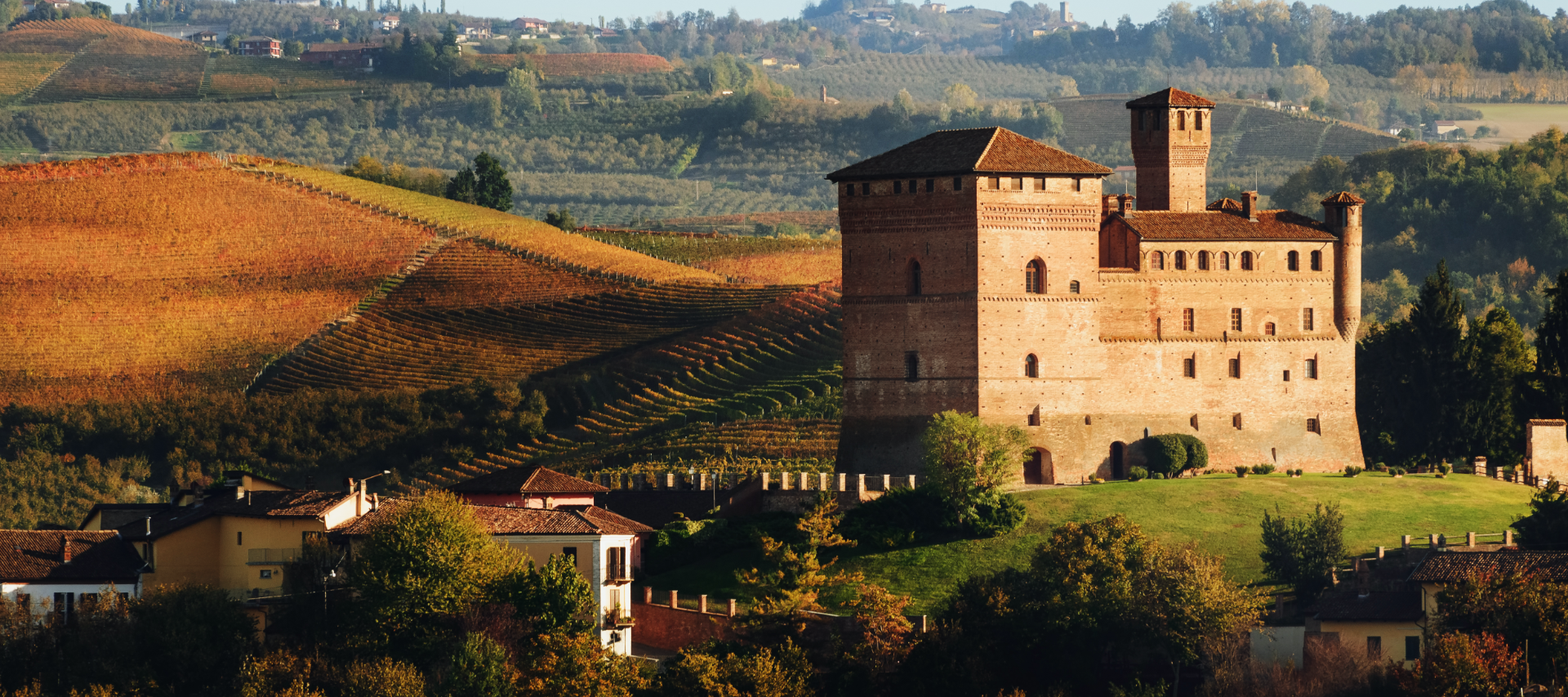
The castle of Grinzane Cavour lies on top of a hill not far from Alba, overlooking the spectacular landscape of the Langhe hills, a Unesco heritage site.
Like any self-respecting castle, the castle of Grinzane Cavour has a long and fascinating history, marked by continuous changes of ownership between counts and countesses, marquises, nobles and wealthy local families.
Owning a castle has always been a sign of power, both in military and economic terms, and therefore the manor of Grinzane has always been highly coveted.
Here are the key moments in its history.

It all starts with the pirates
and Countess Adelaide, 10 centuries ago.
We are at the beginning of the 11th century: on top of the hill there is only a watchtower, used by the locals to control the surrounding area, given the frequent and fearsome incursions of Hungarian-Saracen pirates, who came up from Liguria to plunder the area.
It was probably around the middle of the 11th century that the first structure was built in place of the watchtower; the tall central tower that still characterizes the castle today and that, over time, would become the core around which the various blocks would be added to adapt it to the needs of the several owners who have followed one another over the years.
At that time, the feudal lordship was in the hands of Countess Adelaide di Susa, of the Arduinici family, who gained power and fortune especially when, on her third marriage, she married Oddone di Savoia, son of the progenitor Umberto Biancamano.
Because of her wisdom and integrity, Countess Adelaide was much loved by her subjects, who called her “the Marquise of the Cottian Alps”. She founded cloisters and monasteries, including that of Santa Maria Assunta in Abbadia Alpina. However, she did not bring much luck to her husbands, as she was widowed three times and even buried Oddone of Savoy.
1547. Pietrino Belli’s sumptuous wedding: the Hall of Masks is born.
After the death of Countess Adelaide and the decline of her family, the Castle underwent various changes of ownership until, in 1546, a purchaser from the Alba area, Pietrino Belli, a distinguished jurist and diplomat, arrived.
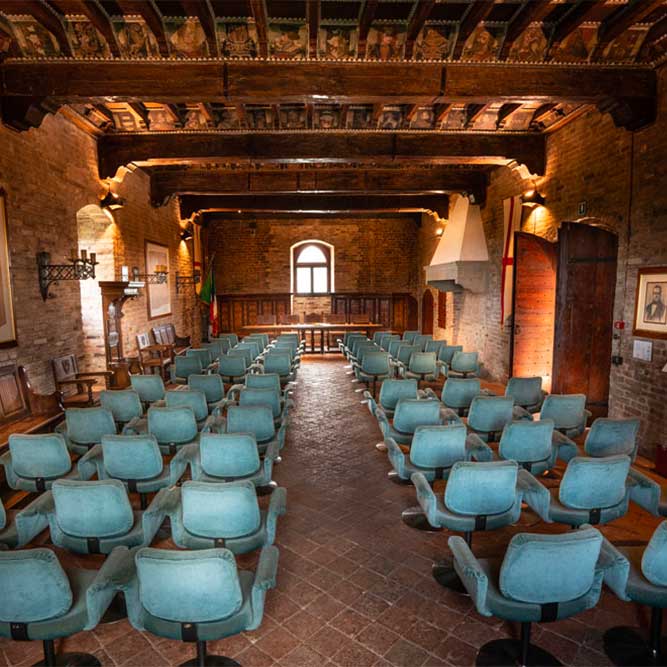
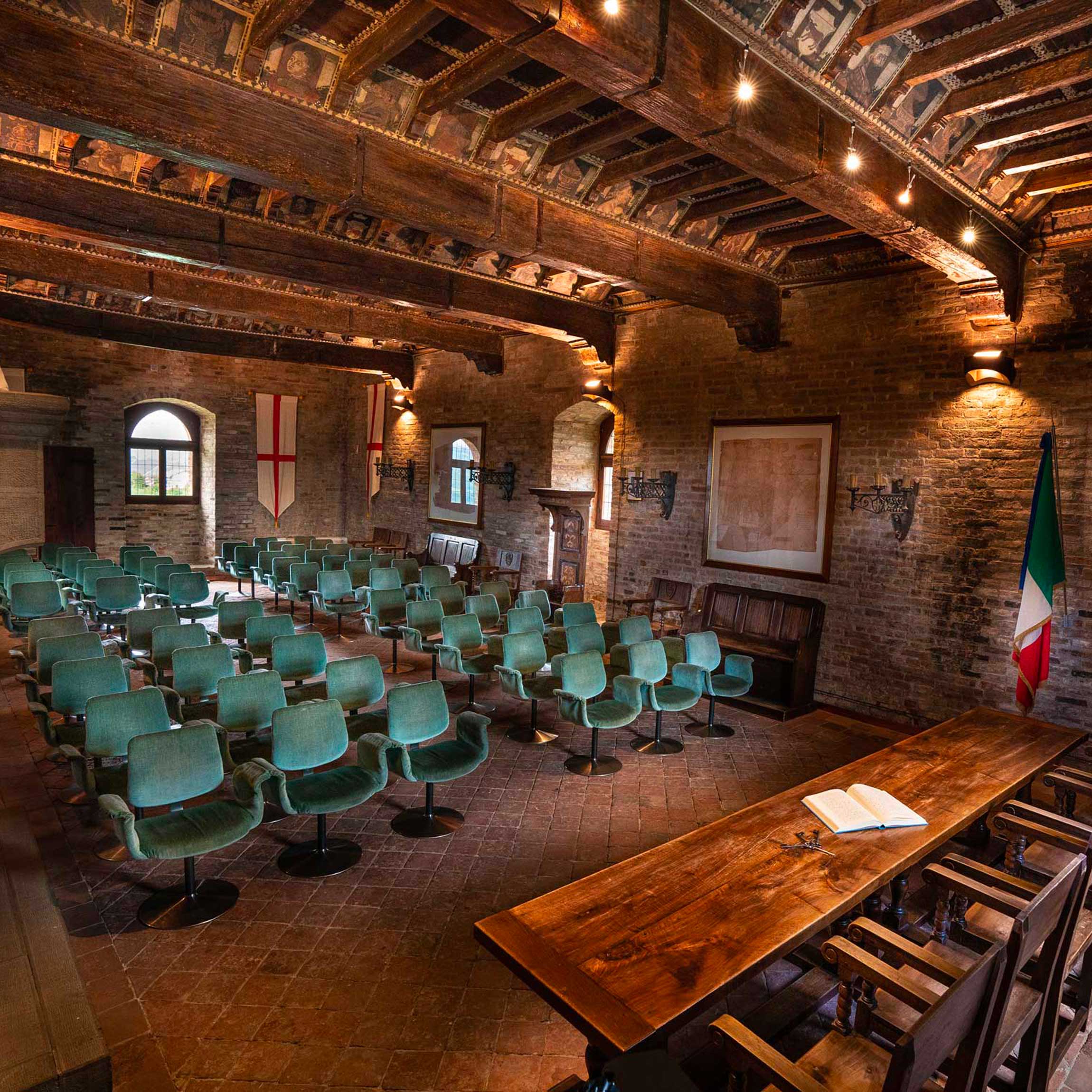
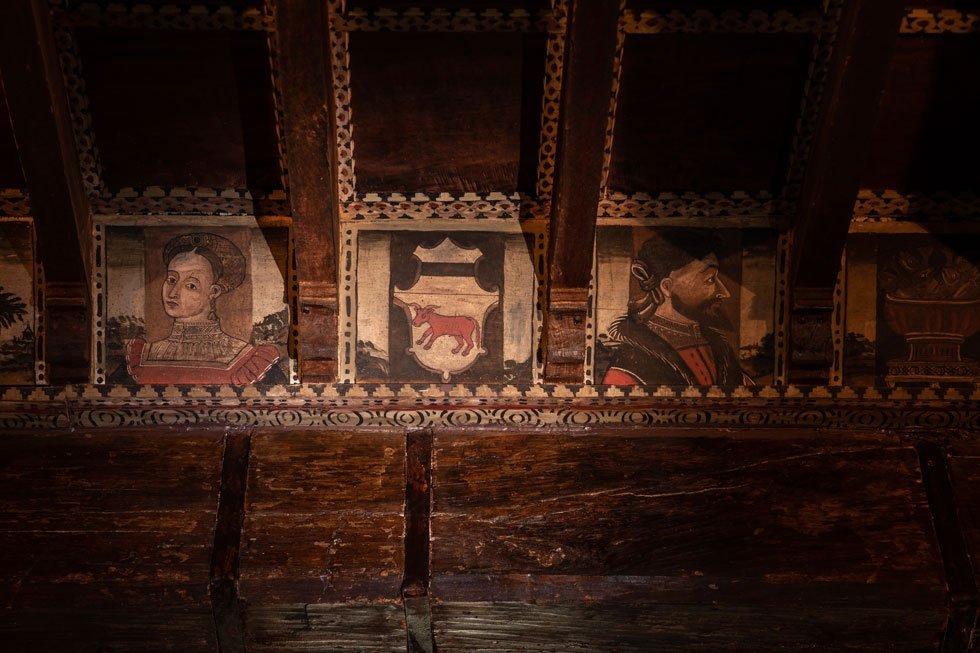
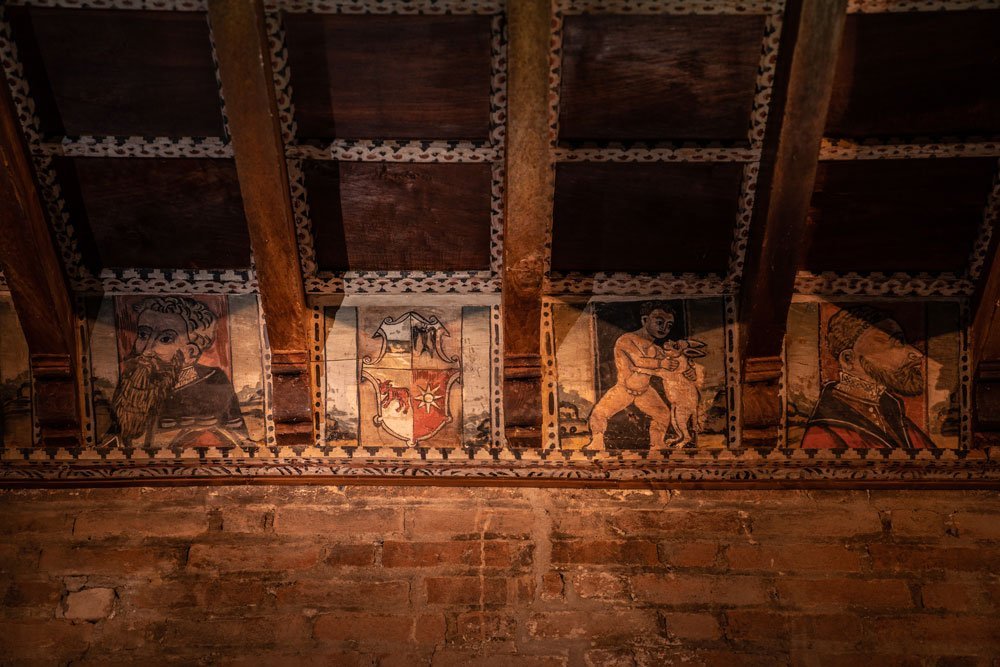
A year later, in order to celebrate properly his marriage to a local noblewoman, Giulia Damiani, Pietrino decided to have a magnificent wooden coffered ceiling built in the reception room, decorated with 156 masks, i.e. paintings of faces, the heraldic coats of arms of the Belli and Donati families, and various allegories, such as representations of animals, a metaphor for human qualities and virtues, and children, symbolising love, playing different musical instruments.
We can picture Pietrino and Giulia, happy newlyweds, dancing in their rich 16th-century clothes a courante, a popular dance of the time, in the luxury of the hall and in the candlelight, to the joy of all their guests.
The Hall of Masks today is open to the public and hosts council meetings, weddings and events, including the prestigious Alba White Truffle World Auction.
Time flies: the 19th century of Napoleon and the Cavour family.
Once Alba and the imperial fiefs were occupied by the Savoy family at the beginning of the 17th century, for almost two centuries various counts and marquises tied to the Savoy family took over the ownership of the fiefdom to which our castle belongs. Until finally, towards the end of the 18th century, a great upheaval swept through Europe: the French Revolution!
Royal and noble heads fell under the blade of the guillotine in Paris: the armies of Austria and Prussia attempted to invade France to restore order, but were unexpectedly defeated by the revolutionary army.
Northern Italy and Piedmont fell under French rule and the exploits of a young general, Napoleon Bonaparte, who defeated the Piedmontese army several times, became legendary. The Savoy family and their court panicked and fled to Austria waiting for better times.
However, the defeat of Waterloo arrived, Napoleon ended up on Saint Helena and Victor Emmanuel I, the King of Sardinia in exile, returned to Turin in 1815 with the aim of re-establishing everything as it was before. Seeing his attempts fail and worried by the revolutionary uprisings of 1821, he abdicated in favour of his brother Charles Felix.
In the meantime, things have changed in Grinzane too: a new family has bought the castle and its large landed estates: it is the Benso family, marquises of Cavour, whose descendants include Camillo.
Cavour at the Castle.
Thanks to a duchess aunt who was not good at accounting.
Background: In 1815, Duchess Vittoria de Sellon, Camillo’s aunt, bought a plot of land in Grinzane: 180 hectares overall, including part of the medieval castle. However, the duchess was not used to practical matters: as she had no idea how to manage that land, she decided to rent it to her brother-in-law Michele Benso, Marquis of Cavour, for four thousand lire a year. It was a valuable piece of land, capable of producing wheat and a special grape from which dolcetti, nebbioli and chiaretti were made.
The Marquis Michele was very busy with the administration of other estates and lands and decided to send his son Camillo to run the estate. Thus, Count Camillo Benso moved there and, at only twenty-two years of age in September 1832, became Mayor of Grinzane.
His arrival in Grinzane was very positive for the Castle and for the district of Grinzane: various improvements were made, but above all Camillo devoted himself with passion and dedication to improve the condition of the agricultural estates around the Castle, starting with the vineyards.
Cavour was Mayor of Grinzane for 17 years, and held the position even when he began his political activities, which led him to become Prime Minister of the Kingdom of Savoy and one of the key players in the Unification of Italy.
The Castle was his favourite residence during his stays in Grinzane. In one of the rooms of the Castle, the Sala Cavour, you can see his bedroom with various memorabilia and original documents.
Stories of mothers and daughters:
Giuseppina Benso
and Adele Alfieri, who donated
the Castle to the Municipality of Alba.
When Camillo and his father died, Giuseppina Benso, Camillo’s favourite niece, inherited the castle.
Her marriage, which took place in 1851 to Carlo Alfieri di Sostegno, cost the family 120,000 lire for the dowry and 50,000 lire for the honeymoon in Paris, where she was also a guest of the banker Rothschild, with whom Camillo was in business.
Giuseppina and Carlo Alfieri had two daughters: Luisa and Adele, who, after the death of their parents, divided the estate between them. The marquise Adele Alfieri di Sostegno inherited Grinzane Castle in the Alba area, with about one hundred hectares of land.
Adele did not marry. With no direct heirs, and wishing to hand down to posterity the memory and remembrance of her great ancestor Camillo Benso di Cavour, she decided that the assets of her property, including the Castle, should pass into the hands of organizations or persons who would be committed to preserving them and carrying out charity work.
The Marquise then began negotiations with the Municipality of Alba which, in the meantime, had been merged with the Municipality of Grinzane (to which, in 1916, the name “Cavour” had been added, in honour of Count Camillo): hence, on 18 October 1932, the official deed of donation was made.
Once the Second World War was over, in 1947, Grinzane Cavour became independent from Alba once again. After careful negotiation, Alba and Grinzane agreed to share ownership of the castle. And this is still the case today.

1961: a restoration 100 years after the Unification of Italy.
To mark the celebrations for the first centenary of the birth of the Italian State, which took place on 17 March 1861, it was decided to restore the Castle as the building was in a state of neglect, and to remove the various construction changes that had distorted its original architecture.
Various works were carried out: the useless external superstructures were demolished, and the farmhouses surrounding the castle, which deprived the spectacular view of its imposing size from below, were removed. Dangerous roofs and walls were consolidated, and windows that had been hidden and compromised the harmony of the façades were reopened. Finally, in some of the rooms, the terracotta floors and sections of walls were repaired and the ceilings reinforced. It was during this work that the beautiful coffered ceiling of the Hall of Masks accidentally came to light.
“the restoration was not limited to repairing the damage caused by time and preserving the monument by restoring its lost integrity, but also had, as essential aim, a new destination that would revive it and prolong its life over time”.
Architect, Andrea Bruno

1967: The Enoteca Regionale Piemontese Cavour (Regional wine shop) is born.
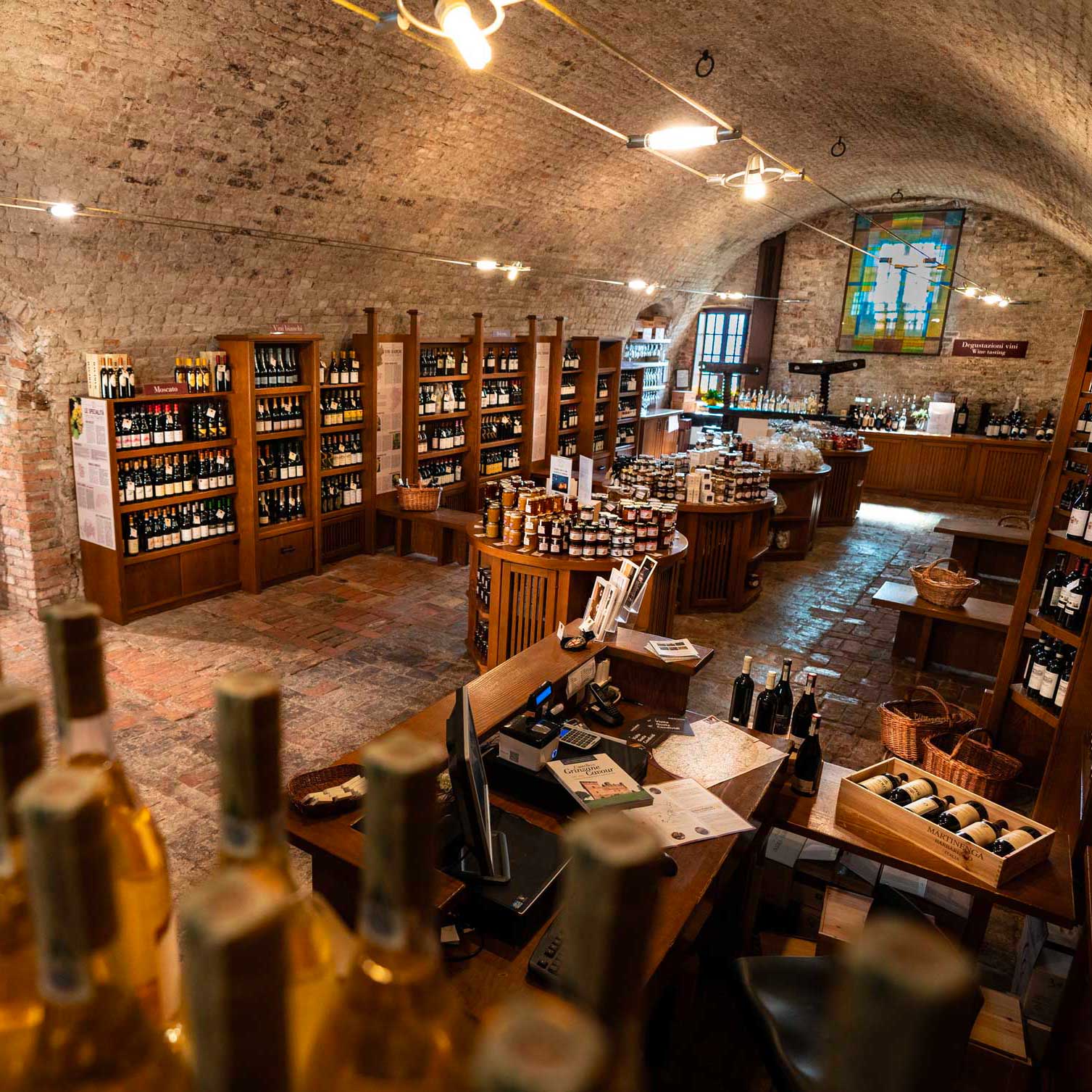
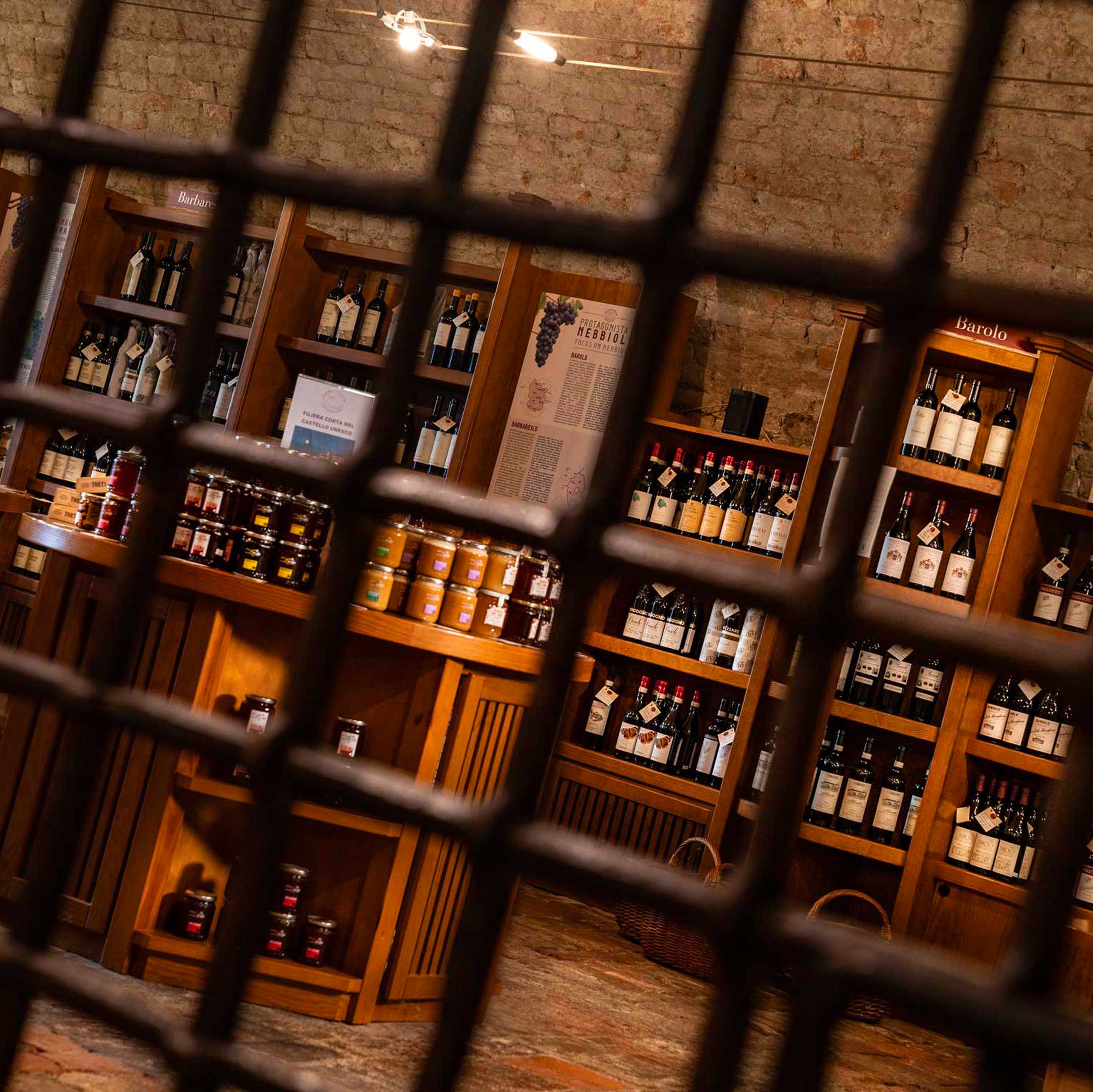
On 27th November 1967, the Enoteca Regionale Piemontese Cavour was inaugurated, the first wine shop of its kind in Piedmont and the second in Italy. The aim of the Enoteca is to promote the knowledge and image of the best wines and food products of the territory.

2021: inauguration of the “In Vigna” OpenAir Museum.
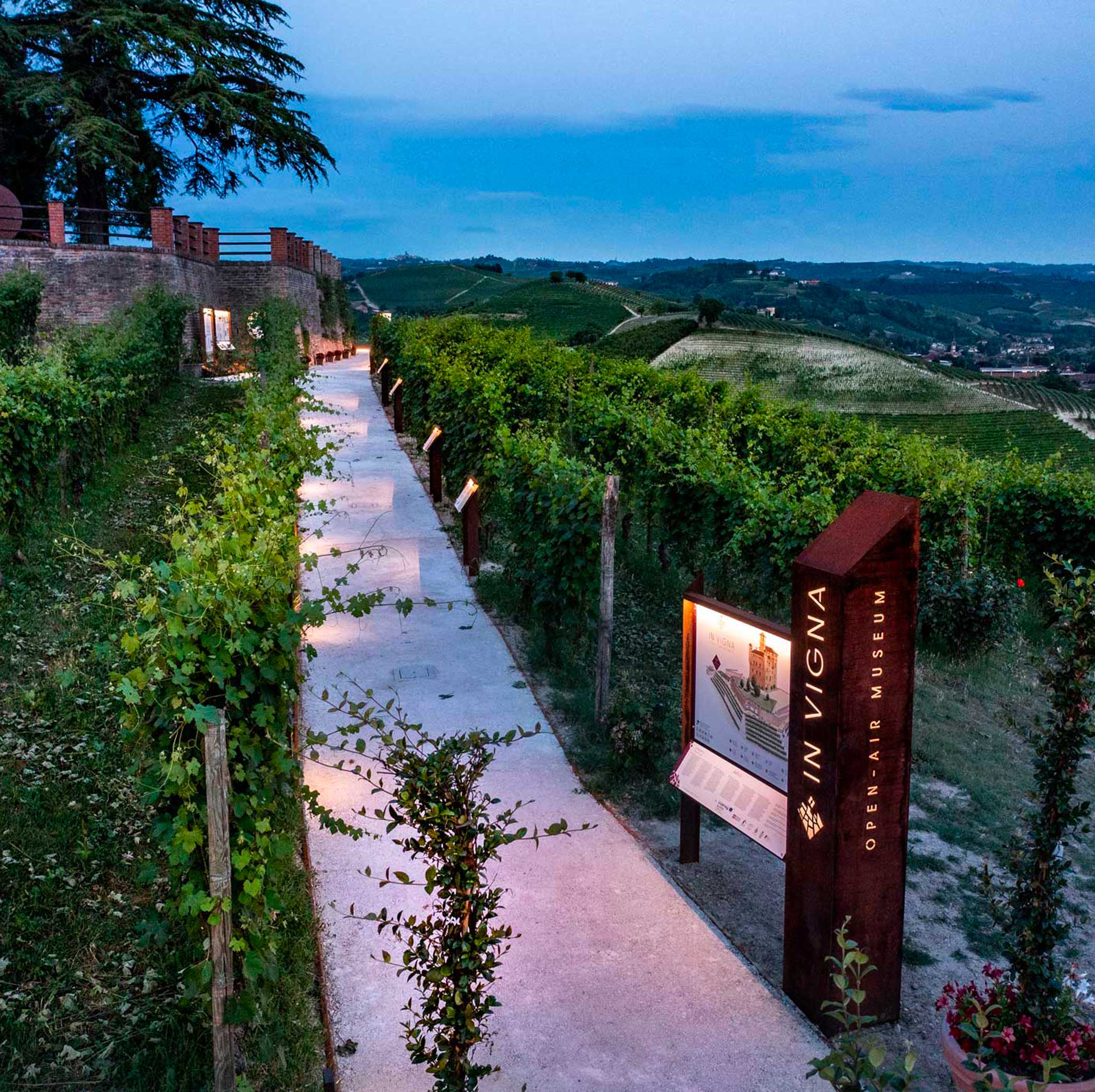
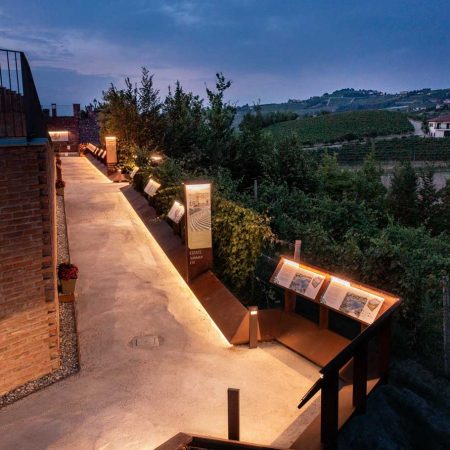
In Vigna is a charming open-air path unfolding around the walls of the Castle. Thanks to various information and story-telling stations along the route, visitors can discover man’s hard work and the changes in the vineyard during the four seasons of the year which will give birth to the extraordinary nectar so love and cherished by Bacchus and the gods: wine.
Are you an expert or a true lover of art and architecture?
The Castle knows how to satisfy your desire for beauty.
The complex and imposing Castle structure, made entirely of exposed brick, consists of a number of distinct buildings, built at different times, with an almost rectangular plan and a courtyard inside, raised above the surrounding ground level, which was fully operational in the first half of the 15th century.
For centuries, clay-brick has been the most widespread material in the Alba area: local people have always been able to manipulate clay and bake it.
The tower
The oldest element is the central tower, dating back to the early 11th century, which is higher than the nearby fortified house and the U-shaped sleeve that surrounds it.
Its current aspect is the result of different construction phases, which have transformed the initial volume into a complex and articulated building, adapted over time to the needs of the various owners.
A full view of the tower, which is solid, elegant and slender, is only possible from the inner courtyard, where visitors can observe the construction characteristics, which are in line with the typical rural medieval style, with its sober and linear layout.
From the outer perimeter, the tower fits into the architectural complex, interacting with the other towers, preserving its individuality, remaining isolated, revealing its construction development and subsequent elevation. The restoration work carried out in 1960 by architect Andrea Bruno returned it to its original aspect, by closing the many openings in the tower that compromised its stability.
The tower is higher than all the other parts of the castle, a dominant element even though it is entirely enclosed by the buildings. A particularly fine example of castle architecture is the northern part, the original fortified house: after restoration it has returned to its original aspect, imposing and airy in its sober construction.
The structure of the Castle
Elegant windows and decorative arches divide the façades, making the massive volume less imposing and recall, in its shape and proportions, the nearby castle of Serralunga d’Alba. The decorations, marking the floors horizontally, are developed on the four sides.
The entire complex is now covered with tile roofs; originally, the old body at least, probably ended with battlements; the next part of the castle, leaning against the fortified house, was probably built between the 14th and 15th centuries; a structure created and designed by the need to connect the two original strong elements, without allowing further extensions to the perimeter, by inserting, on the south front, two characteristic cylindrical, cantilevered corner turrets, which start from the second floor and extend beyond the roof.