



Ethnographics trails.
There is a close connection between nature, culture and local traditions, and in this section it is clearly visibile thanks to the domestic settings of the late 17th and late 19th centuries, with a collection of period objects from past centuries and an interesting photographic exhibition by the master Aldo Agnelli from Alba.
Kitchen evolution from the 17th to the 19th century.
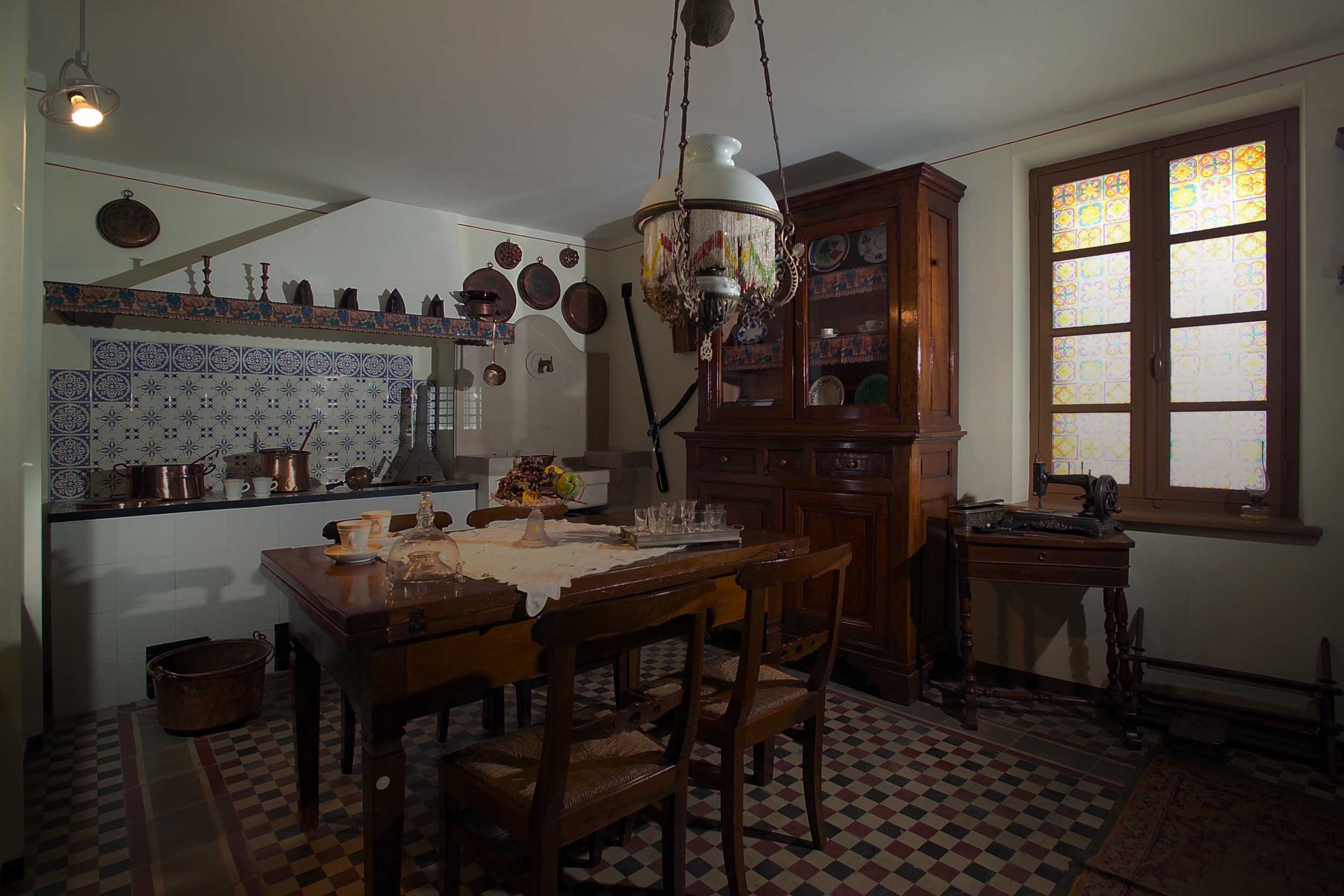
An interesting reconstruction puts the interior of two typical Langhe kitchens in parallel, showing the typical environment of the 17th century and the one that characterized the same domestic environment two centuries later.
From the walnut wood furniture of the early period to the richer cherry wood furnishings of the 19th century, which emphasized the apparent wealth of the farmer who had become a master.
Among the items preserved in these two rooms, special mention should be made of the seventeenth-century “madia“, a work table used to knead and leaven bread, whose inner part, once the upper part was lifted, also served as a cradle, the spinning wheel for spinning wool and the chopping board on which polenta was tipped; When looking back to the 19th century we can also see the water pump, the extendable table, the flytrap, the ironing machine and the irons, which were put on the stove to be heated.